


‘So, what has been the increase in expertise in the workforce over the last year?’ asked the CEO. An unusual question given the setting of the meeting. The CEO had recently taken up his responsibilities at the bank. An industry veteran known for his strategic focus on governance and growth, he had a reputation of deploying technology effectively to meet these goals. The meeting was called with me for the renewal of CRLP (Content-Ready Learning Portal-TC's solution with India-specific content-ready LMS in a SAAS model), and there we were-the CEO and me. I had just finished introducing our new offerings. The highlight was our new offering-Skill Tests, our unique assessment engine based on regulatory circulars and authoritative reference material. ‘No, Mr. Navalkar. I want to deploy L&D strategy for two key objectives,' the CEO shared in clear terms
"
1. To ensure that the increase in knowledge and skills is measurable
2. To recognise and encourage fast trackers to aim for higher goal
"
Necessity is the mother of invention. Till then, TC offered CRLP as an LMS with ready content, which a client could deploy based on their requirements, e.g., compliance courses for regulatory compliance training, domain courses for upgrade of concept and application knowledge, and services for various other needs. The requirement from the CEO got us thinking. And from this requirement were born our Data-focused Learning Plans!
Data-focused Learning Plans (DfLP)
Data-focused Learning Plans provide you with a framework which are built on the above two key objectives
- Employee progress should be measurable in definite terms.
- It should be possible to identify better performers and provide them with incentive to achieve higher results.
DfLPs have some fundamental architectures as below.
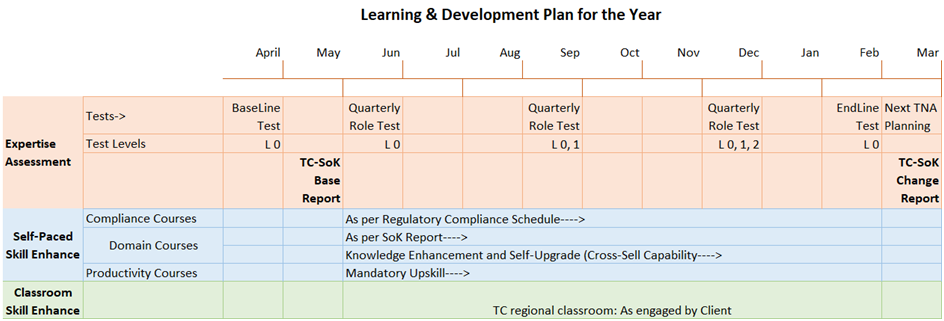
- The Plan starts with and ends with a Test containing the same criteria. The start of the year has the Base-line Test and the end of the period has the Endline Test. Both tests contain similar types of Tests.
- The workforce is categorised in segments based on their seniority or the complexity of tasks assigned to their roles. Juniors get fact-based or concept-based tests, while seniors get case study-based tests to test their decision-making capabilities.
- All Tests are based on Role-based TC Skill Tests. Check Box for ‘Type of Skill Tests’ for an understanding on Skill Tests.
- If the performance of employee in the baseline test is higher than a threshold, he/she will be assigned to a more complex test.
- The L&D Manager can select a range of products, activities and solutions to structure his annual plan by selecting amongst the various products, services, and solutions from TC and its associates. These could include
a. Skill Tests
b. Self-paced E-learning Course
c. Virtual Conference Courses
d. Onboarding Program
e. Special Program for Fast-Trackers
f. All-India In-Person
g. Courses Custom Courseware
h. Gamified implementation - Clients can also add their own or any third-party activities into the Learning Plan.
- All activities are implemented in a gamified environment, with each employee being able to identify his/her ranking in the performance and being able to better the performance for the next round. L&D also receives granular as well as overall reports on the performance of the team.
- Clients have a choice of LMSs to use for implementing the Learning Plans
a. TC’s CRLP LMS or
b. TC’s iSpring LMS (from https://www.ispring.com/)
c. client’s own LMS
Client's own LMS usage will require SSO and API integration to be done with TC’s CRLP LMS. Implementation on TC CRLP LMS is essential as the structure relies on the product features and solution implementations that are designed on the CRLP LM - DfLPs are usually annual, with the first activity being the Baseline Test in April of the year and the last item concluding the measurement of Objective of DfLP through the Endline Test. This is usually conducted in Jan/Feb before the year-end activities kick in.
Here is a small set of slides explaining DfLPs.
Learning Plan Patterns
Based on the framework above, a client can design customised plans based on calendar events already chalked out. The diagram shown below has additional events like Quarterly Role Tests, Special tests and events, classroom
Learning Plan Pattern 1 – TC Products-based Pattern
| Type of Skill Tests Skill Tests are based on industry reference material like regulatory circulars, recommended textbooks for certifications, etc. Key Features of Skill Tests are – 1. Targeted learning tool to assess and upgrade employee knowledge and skills. 2. Context-specific and role-specific tests anchored on circulars (RBI/SEBI/IRDA/GoI) 3. Local language variations for higher effectiveness 4. Validation, Verification and Security through Proctoring, Secure Browser across devices 5. Validity - Content regularly updated in line with the latest regulatory circulars 6. Customisable to include Fis own products, policies and other knowledge requirements 7. Roles for all Financial Institutions – Comm. Banks, UCBs, NBFC, HFCs, MFIs, SFBs Topic-based tests These are based on individual functional areas and are usually mapped to specific RBI Circulars or reference textbooks or chapters therein. E.g. Loans and Advances – Statutory and Other Restrictions, Priority Sector Lending (PSL), Priority Sector Lending (PSL). Refer to the Course Catalogue here to check the currently available Skill Tests. Additional tests can be added on requests. Role-based Tests The work mapped to roles in a Bank (e.g. Teller, Operations Manager, Loan Officer, Branch Manager) incorporate multiple topics or circulars or work areas. Each role needs to apply business rule from multiple areas. E.g. a Retail Banking person has to know the regulatory aspects from circulars of Home Loans, Maintenance of Deposit Accounts, Credit Information Companies, etc. Accordingly, Role-based Tests comprise of aggregation of questions from multiple circular areas. Refer to the sheet ‘Role’in the above Course Catalogue excel file. 1. Role-based tests are created using the tests that are live with TrainingCentral. 2. Role-based tests include circulars as identified by a panel of bankers and finance experts. 3. There is no separate charge for creating these tests. 4. Should a client require a topic which is not there in either the Topic-based tests or Role- based test, the same can be prioritised subject to minimum volume for that test. 5. For custom Role-based Tests (with a different set of topics), a custom-creation charges will apply. |
- Based on the baseline test performance, individuals are assigned to higher complexity
- Compliance courses are assigned based on the segments within the bank or financial institution.
- Tests are administered at regular intervals, encouraging the workforce to keep themselves updated on circulars, trends, products introduced, etc.
- Special tests like JAIIB or other areas can be assigned if our organisation encourages the certification for career furtherance.
Want to try out the activities?
What would you want to implement in your bank, NBFC, Fintech or financial institution? What are the gaps in knowledge and skill that you ‘feel’ are there in the organisation? Do you also want to include custom activities or your product-specific tests in the annual learning plan? Reach out to us and we will be happy to custom-design a learning plan specific to your needs!